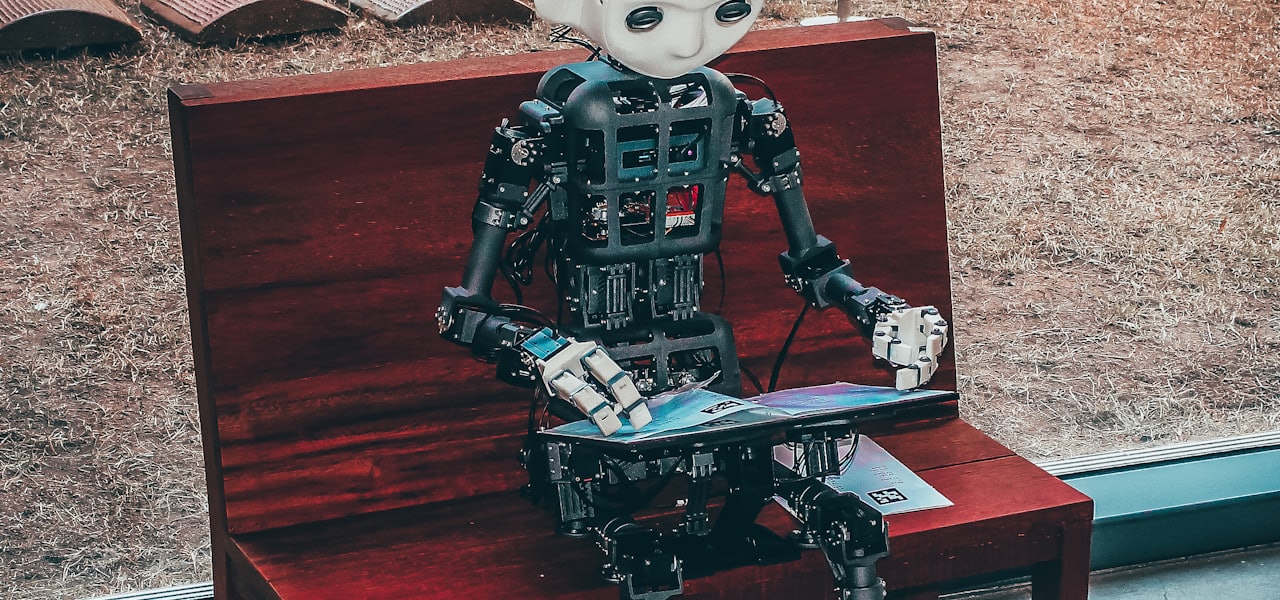
This is a list of notable peer-reviewed academic journals that publish research in the field of artificial intelligence (AI), including areas such as machine learning, computer vision, natural language processing, robotics, and intelligent systems. == General artificial intelligence == Artificial Intelligence (journal) – Elsevier Journal of Artificial Intelligence Research (JAIR) – AI Access Foundation Knowledge-Based Systems – Elsevier == Machine learning == Data Mining and Knowledge Discovery – Springer Machine Learning (journal) – Springer Journal of Machine Learning Research – Microtome Pattern Recognition (journal) – Elsevier Neural Networks (journal) – Elsevier Neural Computation (journal) – MIT Press Neurocomputing (journal) - Elsevier == Deep learning and neural computation == IEEE Transactions on Evolutionary Computation – IEEE IEEE Transactions on Neural Networks and Learning Systems – IEEE Nature Machine Intelligence – Springer Nature == Computer vision == International Journal of Computer Vision – Springer IEEE Transactions on Pattern Analysis and Machine Intelligence – IEEE Machine Vision and Applications – Springer == Natural language processing == Computational Linguistics (journal) – MIT Press Natural Language Processing Transactions of the Association for Computational Linguistics – ACL == Robotics and intelligent systems == IEEE Transactions on Robotics – IEEE Autonomous Robots – Springer Journal of Intelligent & Robotic Systems – Springer == Interdisciplinary and ethics in AI == AI & Society – Springer Artificial Life – MIT Press Philosophy & Technology – Springer Minds and Machines – Springer
Spreading activation
Spreading activation is a method for searching associative networks, biological and artificial neural networks, or semantic networks. The search process is initiated by labeling a set of source nodes (e.g. concepts in a semantic network) with weights or "activation" and then iteratively propagating or "spreading" that activation out to other nodes linked to the source nodes. Most often these "weights" are real values that decay as activation propagates through the network. When the weights are discrete this process is often referred to as marker passing. Activation may originate from alternate paths, identified by distinct markers, and terminate when two alternate paths reach the same node. However brain studies show that several different brain areas play an important role in semantic processing. Spreading activation in semantic networks as a model were invented in cognitive psychology to model the fan out effect. Spreading activation can also be applied in information retrieval, by means of a network of nodes representing documents and terms contained in those documents. == Cognitive psychology == As it relates to cognitive psychology, spreading activation is the theory of how the brain iterates through a network of associated ideas to retrieve specific information. The spreading activation theory presents the array of concepts within our memory as cognitive units, each consisting of a node and its associated elements or characteristics, all connected together by edges. A spreading activation network can be represented schematically, in a sort of web diagram with shorter lines between two nodes meaning the ideas are more closely related and will typically be associated more quickly to the original concept. In memory psychology, the spreading activation model holds that people organize their knowledge of the world based on their personal experiences, which in turn form the network of ideas that is the person's knowledge of the world. When a word (the target) is preceded by an associated word (the prime) in word recognition tasks, participants seem to perform better in the amount of time that it takes them to respond. For instance, subjects respond faster to the word "doctor" when it is preceded by "nurse" than when it is preceded by an unrelated word like "carrot". This semantic priming effect with words that are close in meaning within the cognitive network has been seen in a wide range of tasks given by experimenters, ranging from sentence verification to lexical decision and naming. As another example, if the original concept is "red" and the concept "vehicles" is primed, they are much more likely to say "fire engine" instead of something unrelated to vehicles, such as "cherries". If instead "fruits" was primed, they would likely name "cherries" and continue on from there. The activation of pathways in the network has everything to do with how closely linked two concepts are by meaning, as well as how a subject is primed. == Algorithm == A directed graph is populated by Nodes[ 1...N ] each having an associated activation value A [ i ] which is a real number in the range [0.0 ... 1.0]. A Link[ i, j ] connects source node[ i ] with target node[ j ]. Each edge has an associated weight W [ i, j ] usually a real number in the range [0.0 ... 1.0]. Parameters: Firing threshold F, a real number in the range [0.0 ... 1.0] Decay factor D, a real number in the range [0.0 ... 1.0] Steps: Initialize the graph setting all activation values A [ i ] to zero. Set one or more origin nodes to an initial activation value greater than the firing threshold F. A typical initial value is 1.0. For each unfired node [ i ] in the graph having an activation value A [ i ] greater than the node firing threshold F: For each Link [ i, j ] connecting the source node [ i ] with target node [ j ], adjust A [ j ] = A [ j ] + (A [ i ] W [ i, j ] D) where D is the decay factor. If a target node receives an adjustment to its activation value so that it would exceed 1.0, then set its new activation value to 1.0. Likewise maintain 0.0 as a lower bound on the target node's activation value should it receive an adjustment to below 0.0. Once a node has fired it may not fire again, although variations of the basic algorithm permit repeated firings and loops through the graph. Nodes receiving a new activation value that exceeds the firing threshold F are marked for firing on the next spreading activation cycle. If activation originates from more than one node, a variation of the algorithm permits marker passing to distinguish the paths by which activation is spread over the graph The procedure terminates when either there are no more nodes to fire or in the case of marker passing from multiple origins, when a node is reached from more than one path. Variations of the algorithm that permit repeated node firings and activation loops in the graph, terminate after a steady activation state, with respect to some delta, is reached, or when a maximum number of iterations is exceeded. == Examples ==
State complexity
State complexity is an area of theoretical computer science dealing with the size of abstract automata, such as different kinds of finite automata. The classical result in the area is that simulating an n {\displaystyle n} -state nondeterministic finite automaton by a deterministic finite automaton requires exactly 2 n {\displaystyle 2^{n}} states in the worst case. == Transformation between variants of finite automata == Finite automata can be deterministic and nondeterministic, one-way (DFA, NFA) and two-way (2DFA, 2NFA). Other related classes are unambiguous (UFA), self-verifying (SVFA) and alternating (AFA) finite automata. These automata can also be two-way (2UFA, 2SVFA, 2AFA). All these machines can accept exactly the regular languages. However, the size of different types of automata necessary to accept the same language (measured in the number of their states) may be different. For any two types of finite automata, the state complexity tradeoff between them is an integer function f {\displaystyle f} where f ( n ) {\displaystyle f(n)} is the least number of states in automata of the second type sufficient to recognize every language recognized by an n {\displaystyle n} -state automaton of the first type. The following results are known. NFA to DFA: 2 n {\displaystyle 2^{n}} states. This is the subset construction by Rabin and Scott, proved optimal by Lupanov. UFA to DFA: 2 n {\displaystyle 2^{n}} states, see Leung, An earlier lower bound by Schmidt was smaller. NFA to UFA: 2 n − 1 {\displaystyle 2^{n}-1} states, see Leung. There was an earlier smaller lower bound by Schmidt. SVFA to DFA: Θ ( 3 n / 3 ) {\displaystyle \Theta (3^{n/3})} states, see Jirásková and Pighizzini 2DFA to DFA: n ( n n − ( n − 1 ) n ) {\displaystyle n(n^{n}-(n-1)^{n})} states, see Kapoutsis. Earlier construction by Shepherdson used more states, and an earlier lower bound by Moore was smaller. 2DFA to NFA: ( 2 n n + 1 ) = O ( 4 n n ) {\displaystyle {\binom {2n}{n+1}}=O({\frac {4^{n}}{\sqrt {n}}})} , see Kapoutsis. Earlier construction by Birget used more states. 2NFA to NFA: ( 2 n n + 1 ) {\displaystyle {\binom {2n}{n+1}}} , see Kapoutsis. 2NFA to NFA accepting the complement: O ( 4 n ) {\displaystyle O(4^{n})} states, see Vardi. AFA to DFA: 2 2 n {\displaystyle 2^{2^{n}}} states, see Chandra, Kozen and Stockmeyer. AFA to NFA: 2 n {\displaystyle 2^{n}} states, see Fellah, Jürgensen and Yu. 2AFA to DFA: 2 n 2 n {\displaystyle 2^{n2^{n}}} , see Ladner, Lipton and Stockmeyer. 2AFA to NFA: 2 Θ ( n log n ) {\displaystyle 2^{\Theta (n\log n)}} , see Geffert and Okhotin. === The 2DFA vs. 2NFA problem and logarithmic space === It is an open problem whether all 2NFAs can be converted to 2DFAs with polynomially many states, i.e. whether there is a polynomial p ( n ) {\displaystyle p(n)} such that for every n {\displaystyle n} -state 2NFA there exists a p ( n ) {\displaystyle p(n)} -state 2DFA. The problem was raised by Sakoda and Sipser, who compared it to the P vs. NP problem in the computational complexity theory. Berman and Lingas discovered a formal relation between this problem and the L vs. NL open problem. This relation was further elaborated by Kapoutsis. == State complexity of operations for finite automata == Given a binary regularity-preserving operation on languages ∘ {\displaystyle \circ } and a family of automata X (DFA, NFA, etc.), the state complexity of ∘ {\displaystyle \circ } is an integer function f ( m , n ) {\displaystyle f(m,n)} such that for each m-state X-automaton A and n-state X-automaton B there is an f ( m , n ) {\displaystyle f(m,n)} -state X-automaton for L ( A ) ∘ L ( B ) {\displaystyle L(A)\circ L(B)} , and for all integers m, n there is an m-state X-automaton A and an n-state X-automaton B such that every X-automaton for L ( A ) ∘ L ( B ) {\displaystyle L(A)\circ L(B)} must have at least f ( m , n ) {\displaystyle f(m,n)} states. Analogous definition applies for operations with any number of arguments. The first results on state complexity of operations for DFAs were published by Maslov and by Yu, Zhuang and Salomaa. Holzer and Kutrib pioneered the state complexity of operations on NFA. The known results for basic operations are listed below. === Union === If language L 1 {\displaystyle L_{1}} requires m states and language L 2 {\displaystyle L_{2}} requires n states, how many states does L 1 ∪ L 2 {\displaystyle L_{1}\cup L_{2}} require? DFA: m n {\displaystyle mn} states, see Maslov and Yu, Zhuang and Salomaa. NFA: m + n + 1 {\displaystyle m+n+1} states, see Holzer and Kutrib. UFA: at least min ( n , m ) Ω ( log ( min ( n , m ) ) ) {\displaystyle \min(n,m)^{\Omega (\log(\min(n,m)))}} ; between m n + m + n {\displaystyle mn+m+n} and m + n m 2 0.79 m {\displaystyle m+nm2^{0.79m}} states, see Jirásek, Jirásková and Šebej. SVFA: m n {\displaystyle mn} states, see Jirásek, Jirásková and Szabari. 2DFA: between m + n {\displaystyle m+n} and 4 m + n + 4 {\displaystyle 4m+n+4} states, see Kunc and Okhotin. 2NFA: m + n {\displaystyle m+n} states, see Kunc and Okhotin. === Intersection === How many states does L 1 ∩ L 2 {\displaystyle L_{1}\cap L_{2}} require? DFA: m n {\displaystyle mn} states, see Maslov and Yu, Zhuang and Salomaa. NFA: m n {\displaystyle mn} states, see Holzer and Kutrib. UFA: m n {\displaystyle mn} states, see Jirásek, Jirásková and Šebej. SVFA: m n {\displaystyle mn} states, see Jirásek, Jirásková and Szabari. 2DFA: between m + n {\displaystyle m+n} and m + n + 1 {\displaystyle m+n+1} states, see Kunc and Okhotin. 2NFA: between m + n {\displaystyle m+n} and m + n + 1 {\displaystyle m+n+1} states, see Kunc and Okhotin. === Complementation === If language L requires n states then how many states does its complement require? DFA: n {\displaystyle n} states, by exchanging accepting and rejecting states. NFA: 2 n {\displaystyle 2^{n}} states, see Birget. or Jirásková UFA: at least n Ω ~ ( log n ) {\displaystyle n^{{\tilde {\Omega }}(\log n)}} states, see Göös, Kiefer and Yuan, (this follows an earlier bound by Raskin); and at most n + 1 ⋅ 2 0.5 n {\displaystyle {\sqrt {n+1}}\cdot 2^{0.5n}} states, see Indzhev and Kiefer. SVFA: n {\displaystyle n} states, by exchanging accepting and rejecting states. 2DFA: at least n {\displaystyle n} and at most 4 n {\displaystyle 4n} states, see Geffert, Mereghetti and Pighizzini. === Concatenation === How many states does L 1 L 2 = { w 1 w 2 ∣ w 1 ∈ L 1 , w 2 ∈ L 2 } {\displaystyle L_{1}L_{2}=\{w_{1}w_{2}\mid w_{1}\in L_{1},w_{2}\in L_{2}\}} require? DFA: m ⋅ 2 n − 2 n − 1 {\displaystyle m\cdot 2^{n}-2^{n-1}} states, see Maslov and Yu, Zhuang and Salomaa. NFA: m + n {\displaystyle m+n} states, see Holzer and Kutrib. UFA: 3 4 2 m + n − 1 {\displaystyle {\frac {3}{4}}2^{m+n}-1} states, see Jirásek, Jirásková and Šebej. SVFA: Θ ( 3 n / 3 2 m ) {\displaystyle \Theta (3^{n/3}2^{m})} states, see Jirásek, Jirásková and Szabari. 2DFA: at least 2 Ω ( n ) log m {\displaystyle {\frac {2^{\Omega (n)}}{\log m}}} and at most 2 m m + 1 ⋅ 2 n n + 1 {\displaystyle 2m^{m+1}\cdot 2^{n^{n+1}}} states, see Jirásková and Okhotin. === Kleene star === DFA: 3 4 2 n {\displaystyle {\frac {3}{4}}2^{n}} states, see Maslov and Yu, Zhuang and Salomaa. NFA: n + 1 {\displaystyle n+1} states, see Holzer and Kutrib. UFA: 3 4 2 n {\displaystyle {\frac {3}{4}}2^{n}} states, see Jirásek, Jirásková and Šebej. SVFA: 3 4 2 n {\displaystyle {\frac {3}{4}}2^{n}} states, see Jirásek, Jirásková and Szabari. 2DFA: at least 1 n 2 n 2 − 1 {\displaystyle {\frac {1}{n}}2^{{\frac {n}{2}}-1}} and at most 2 O ( n n + 1 ) {\displaystyle 2^{O(n^{n+1})}} states, see Jirásková and Okhotin. === Reversal === DFA: 2 n {\displaystyle 2^{n}} states, see Mirkin, Leiss, and Yu, Zhuang and Salomaa. NFA: n + 1 {\displaystyle n+1} states, see Holzer and Kutrib. UFA: n {\displaystyle n} states. SVFA: 2 n + 1 {\displaystyle 2n+1} states, see Jirásek, Jirásková and Szabari. 2DFA: between n + 1 {\displaystyle n+1} and n + 2 {\displaystyle n+2} states, see Jirásková and Okhotin. == Finite automata over a unary alphabet == State complexity of finite automata with a one-letter (unary) alphabet, pioneered by Chrobak, is different from the multi-letter case. Let g ( n ) = e Θ ( n ln n ) {\displaystyle g(n)=e^{\Theta ({\sqrt {n\ln n}})}} be Landau's function. === Transformation between models === For a one-letter alphabet, transformations between different types of finite automata are sometimes more efficient than in the general case. NFA to DFA: g ( n ) + O ( n 2 ) {\displaystyle g(n)+O(n^{2})} states, see Chrobak. 2DFA to DFA: g ( n ) + O ( n ) {\displaystyle g(n)+O(n)} states, see Chrobak and Kunc and Okhotin. 2NFA to DFA: O ( g ( n ) ) {\displaystyle O(g(n))} states, see Mereghetti and Pighizzini. and Geffert, Mereghetti and Pighizzini. NFA to 2DFA: at most O ( n 2 ) {\displaystyle O(n^{2})} states, see Chrobak. 2NFA to 2DFA: at most n O ( log n ) {\displaystyle n^{O(\log n)}} states, proved by implementing the method of Savitch's theorem, see
András Kornai
András Kornai (born 1957 in Budapest) is a mathematical linguist. == Education == Kornai is the son of economist János Kornai. He earned two PhDs with the first being in mathematics in 1983 from Eötvös Loránd University in Budapest, where his advisor was Miklós Ajtai. His second was in linguistics in 1991 from Stanford University, where his advisor was Paul Kiparsky. == Career == He is a professor in the Department of Algebra at the Budapest Institute of Technology, where he works on an open source Hungarian morphological analyzer. He was Chief Scientist at MetaCarta, where he worked on information extraction before the company was acquired by Nokia. Prior to MetaCarta, he was Chief Scientist at Northern Light. He is on the board of the journal Grammars and YourAmigo PLC. His research interests include all mathematical aspects of natural language processing, speech recognition, and OCR. As area editor he was responsible for the Mathematical Linguistics area of the Oxford International Encyclopedia of Linguistics, and his joint work with Geoffrey Pullum, "The X-bar Theory of Phrase Structure", formally reconstructed that then-popular linguistic theory. == Awards and honors == 2009: ACM Distinguished Member == Monographs == Semantics. Springer Nature, 2020. ISBN 978-3-319-65644-1 Mathematical Linguistics. Springer Verlag, in the series Advanced Information and Knowledge Processing, November 2007. ISBN 978-1-84628-985-9 Hardbound, approximately 300 pages. See description. Formal Phonology. In the series Outstanding Dissertations in Linguistics, Garland Publishing, 1994, ISBN 0-8153-1730-1, hardbound, 240 pages Contents, Preface, Introduction (20 pages) On Hungarian Morphology. In the series Linguistica, Hungarian Academy of Sciences, 1994, ISBN 963-8461-73-X, paperbound, 174 pages Contents, Preface, Introduction (10 pages) == Books edited == Oxford International Encyclopedia of Linguistics (Mathematical Linguistics Area Editor under Editor in Chief William Frawley). 4 volumes, Oxford University Press, 2003, ISBN 978-0-19-513977-8. Proceedings of the HLT-NAACL Workshop on the Analysis of Geographic References. Jointly with Beth Sundheim. Association for Computational Linguistics, 2003, ISBN 1-932432-04-3 (WS9), paperbound, vi+81 pages. See related material. Extended Finite State Models of Language (editor). In the series Studies in Natural Language Processing, Cambridge University Press, 1999, ISBN 0-521-63198-X, hardbound, x+278 pages Contents, Introduction (7 pages). == Selected papers == Digital Language Death. PLoS ONE 8(10): e77056, 2012. [1] Hunmorph: open source word analysis (Jointly with V. Tron, Gy. Gyepesi, P. Halacsy, L. Nemeth, and D. Varga). In Proc. ACL 2005 Software Workshop 77-85 [2] Leveraging the open source ispell codebase for minority language analysis (Jointly with P. Halacsy, L. Nemeth, A. Rung, I. Szakadat, and V. Tron). In J. Carson-Berndsen (ed): Proc. SALTMIL 2004 56-59 [3] Explicit Finitism, International Journal of Theoretical Physics 2003/2 301-307 [4] Mathematical Linguistics (Jointly with G.K. Pullum) In W. Frawley (ed): Oxford International Encyclopedia of Linguistics, Oxford University Press 2003, v3 17-20 [5] Optical Character Recognition, In W. Frawley (ed): Oxford International Encyclopedia of Linguistics, Oxford University Press 2003, v3 33-34 [6] How many words are there? Glottometrics 2002/4 61-86 [7] Zipf's law outside the middle range Proc. Sixth Meeting on Mathematics of Language University of Central Florida, 1999 347-356 [8] A Robust, Language-Independent OCR System. (Jointly with Z. Lu, I. Bazzi, J. Makhoul, P. Natarajan, and R. Schwartz) In: Robert J. Mericsko (ed): Proc. 27th AIPR Workshop: Advances in Computer-Assisted Recognition SPIE Proceedings 3584 1999 [9] Quantitative Comparison of Languages. Grammars 1998/2 155-165 [10] The generative power of feature geometry. Annals of Mathematics and Artificial Intelligence 8 1993 37-46 [11] The X-bar Theory of Phrase Structure. (Jointly with G.K. Pullum) Language 66 1990 24-50 [12]
The Best Free AI Presentation Maker for Beginners
Shopping for the best AI presentation maker? An AI presentation maker is software that uses machine learning to help you get more done — it keeps getting smarter as the underlying models improve. Pricing, accuracy, and the size of the model behind the tool are the three factors that most affect daily usefulness. Whether you are a beginner or a pro, the right AI presentation maker slots into your workflow and pays for itself fast. Below we compare features, pricing, and real output so you can choose with confidence.
AppBlock
AppBlock is a software tool for managing screen time that limits access to selected mobile applications and websites. Developed by the Czech studio MobileSoft, it is distributed for Android and iOS devices as well as through browser extensions for Google Chrome, Microsoft Edge and Brave, and as desktop solutions. The application is used primarily to restrict time spent on social media and similar distracting services while working and studying. By 2025, the application reported 700,000 monthly active users, with the domestic Czech market accounting for less than one percent of its total user base and revenue. == History == === Origins === AppBlock was created by the Czech software studio MobileSoft, based in Hradec Králové. The studio was founded in 2012 by Miroslav Novosvětský, who remains the sole owner. The idea for the application arose from the use of browser-based website blockers on desktop computers. AppBlock was conceived as a way to reduce the time spent on mobile devices. === Early releases === In its early phase, AppBlock was available only for phones running on Android. Early versions allowed users to limit access to selected applications and websites during specified periods. From the outset, the application was distributed internationally rather than only within the Czech market, and early coverage reported a multi-million number of downloads worldwide. === Expansion of functionality === Over time, AppBlock has expanded beyond basic application blocking to include additional functions related to limiting procrastination and managing attention. The development of AppBlock accelerated during the COVID-19 pandemic. Following a reduction in external client orders, the studio reallocated resources from contract development to the application. Increased digital content consumption during lockdowns contributed to a rise in the application's usage and revenue. As the application developed, it became the company's product with the largest user base. Novosvětský described an increase in downloads over a twelve-month period, which he linked in part to the company's activities abroad, including participation in events focused on mobile marketing in the United States. These activities were an important factor in the further development of AppBlock. === Internationalization and market expansion === Within roughly the first eight years of the company's existence, MobileSoft became active both in the domestic Czech market and in the United States, supported among other things by participation in the CzechAccelerator program, which is intended to help Czech firms enter foreign markets. In mid-August 2021 the developers launched a version for iOS, which soon began to attract paying users. The expansion to iOS was accompanied by plans for cooperation with the Procrastination.com platform, intended to complement the blocking functions with educational content related to digital media use, sleep and work habits. By 2025, AppBlock was localised into 15 languages, with the largest share of users in the United States, the United Kingdom, Germany, and France, with recent growth in Brazil, and usage extending across several continents. AppBlock has reached more than 10 million installations. In the same period its creators announced plans to refine existing functions and to expand support beyond mobile phones to desktop use, including through support for additional web browsers. == Features == === Supported platforms === AppBlock is distributed as a mobile application for Android and iOS users through Google Play and the Apple App Store. Browser extensions for desktop systems are available for Google Chrome, Microsoft Edge and Brave. === Functionality === AppBlock's core function is to restrict access to selected applications and websites. The mobile application shows a list of installed apps and lets the user select which ones to block. It also includes tools to block specific websites and, on iOS, to block certain phrases entered in the Safari browser. AppBlock can mute notifications from selected applications, so alerts from those apps do not appear while blocking is active. In addition to choosing which apps or content to block, the software also offers an allowlist mode, where only selected applications remain accessible and all others are blocked. Blocking rules are organized into configurable schedules, called profiles. Users can create profiles that define time periods when selected apps and websites are unavailable. Newer versions also allow profiles to be activated automatically based on the time of day, days of the week, the device's location, or connection to specific Wi-Fi networks. The iOS version lets users set limits on how often or how long certain apps can be used before they are blocked, and it can track and restrict screen time for individual apps. In addition to these recurring rules, AppBlock includes a Quick Block feature that temporarily blocks selected apps and websites with a single action, without requiring a separate long-term schedule. Strict Mode is an optional setting that limits the ability to change blocking once it is active. For a specified period, it prevents editing AppBlock's rules and can be configured to stop the app from being uninstalled during that time. While Strict Mode is enabled, users cannot modify or disable the restrictions they have set. Deactivation requires specific verification steps, such as connecting the device to a charger or obtaining approval from a designated contact person. The mobile application also includes statistical and reporting features. In addition to blocking, AppBlock lets users view statistics and data about their use of applications and websites, including screen-time summaries and focus sessions that silence notifications and enforce blocking during defined work or study periods. Browser extensions for desktop environments apply AppBlock's website-blocking functions on Windows and macOS systems through supported web browsers. == Business model == AppBlock uses a freemium revenue model. The basic version of the application is available free of charge and allows blocking of up to three applications at the same time. The premium version removes this limit and adds further configuration options. In 2020, the application shifted from a one-time payment structure to a subscription model. By 2021, AppBlock had more than seven thousand paying users and annual revenue of about four million Czech crowns. By 2025, annual revenue reached approximately 4 million US dollars (80 million CZK) before taxes and platform fees, with roughly 20 percent of active users subscribing to the paid version. == Usage == AppBlock limits access to selected applications and websites in order to reduce smartphone overuse and digital distraction. It is used to block social media, games and other services considered addictive, with the aim of reducing frequent checking of mobile devices and creating time intervals in which these services are unavailable. Reported use cases of AppBlock cover work, students, parents, ADHD, mental health, well-being and business. The application is used both by individual users and within workplace initiatives in which employees install it to reduce digital distractions during working hours.
Regular language
In theoretical computer science and formal language theory, a regular language (also called a rational language) is a formal language that can be defined by a regular expression, in the strict sense in theoretical computer science (as opposed to many modern regular expression engines, which are augmented with features that allow the recognition of non-regular languages). Alternatively, a regular language can be defined as a language recognised by a finite automaton. The equivalence of regular expressions and finite automata is known as Kleene's theorem (after American mathematician Stephen Cole Kleene). In the Chomsky hierarchy, regular languages are the languages generated by Type-3 grammars. == Formal definition == The collection of regular languages over an alphabet Σ is defined recursively as follows: The empty language ∅ is a regular language. For each a ∈ Σ (a belongs to Σ), the singleton language {a} is a regular language. If A is a regular language, A (Kleene star) is a regular language. Due to this, the empty string language {ε} is also regular. If A and B are regular languages, then A ∪ B (union) and A • B (concatenation) are regular languages. No other languages over Σ are regular. See Regular expression § Formal language theory for syntax and semantics of regular expressions. == Examples == All finite languages are regular; in particular the empty string language {ε} = ∅ is regular. Other typical examples include the language consisting of all strings over the alphabet {a, b} which contain an even number of as, or the language consisting of all strings of the form: several as followed by several bs. A simple example of a language that is not regular is the set of strings {anbn | n ≥ 0}. Intuitively, it cannot be recognized with a finite automaton, since a finite automaton has finite memory and it cannot remember the exact number of a's. Techniques to prove this fact rigorously are given below. == Equivalent formalisms == A regular language satisfies the following equivalent properties: it is the language of a regular expression (by the above definition) it is the language accepted by a nondeterministic finite automaton (NFA) it is the language accepted by a deterministic finite automaton (DFA) it can be generated by a regular grammar it is the language accepted by an alternating finite automaton it is the language accepted by a two-way finite automaton it can be generated by a prefix grammar it can be accepted by a read-only Turing machine it can be defined in monadic second-order logic (Büchi–Elgot–Trakhtenbrot theorem) it is recognized by some finite syntactic monoid M, meaning it is the preimage {w ∈ Σ | f(w) ∈ S} of a subset S of a finite monoid M under a monoid homomorphism f : Σ → M from the free monoid on its alphabet the number of equivalence classes of its syntactic congruence is finite. (This number equals the number of states of the minimal deterministic finite automaton accepting L.) Properties 10. and 11. are purely algebraic approaches to define regular languages; a similar set of statements can be formulated for a monoid M ⊆ Σ. In this case, equivalence over M leads to the concept of a recognizable language. Some authors use one of the above properties different from "1." as an alternative definition of regular languages. Some of the equivalences above, particularly those among the first four formalisms, are called Kleene's theorem in textbooks. Precisely which one (or which subset) is called such varies between authors. One textbook calls the equivalence of regular expressions and NFAs ("1." and "2." above) "Kleene's theorem". Another textbook calls the equivalence of regular expressions and DFAs ("1." and "3." above) "Kleene's theorem". Two other textbooks first prove the expressive equivalence of NFAs and DFAs ("2." and "3.") and then state "Kleene's theorem" as the equivalence between regular expressions and finite automata (the latter said to describe "recognizable languages"). A linguistically oriented text first equates regular grammars ("4." above) with DFAs and NFAs, calls the languages generated by (any of) these "regular", after which it introduces regular expressions which it terms to describe "rational languages", and finally states "Kleene's theorem" as the coincidence of regular and rational languages. Other authors simply define "rational expression" and "regular expressions" as synonymous and do the same with "rational languages" and "regular languages". Apparently, the term regular originates from a 1951 technical report where Kleene introduced regular events and explicitly welcomed "any suggestions as to a more descriptive term". Noam Chomsky, in his 1959 seminal article, used the term regular in a different meaning at first (referring to what is called Chomsky normal form today), but noticed that his finite state languages were equivalent to Kleene's regular events. == Closure properties == The regular languages are closed under various operations, that is, if the languages K and L are regular, so is the result of the following operations: the set-theoretic Boolean operations: union K ∪ L, intersection K ∩ L, and complement L, hence also relative complement K − L. the regular operations: K ∪ L, concatenation K ∘ L {\displaystyle K\circ L} , and Kleene star L. the trio operations: string homomorphism, inverse string homomorphism, and intersection with regular languages. As a consequence they are closed under arbitrary finite state transductions, like quotient K / L with a regular language. Even more, regular languages are closed under quotients with arbitrary languages: If L is regular then L / K is regular for any K. the reverse (or mirror image) LR. Given a nondeterministic finite automaton to recognize L, an automaton for LR can be obtained by reversing all transitions and interchanging starting and finishing states. This may result in multiple starting states; ε-transitions can be used to join them. == Decidability properties == Given two deterministic finite automata A and B, it is decidable whether they accept the same language. As a consequence, using the above closure properties, the following problems are also decidable for arbitrarily given deterministic finite automata A and B, with accepted languages LA and LB, respectively: Containment: is LA ⊆ LB ? Disjointness: is LA ∩ LB = {} ? Emptiness: is LA = {} ? Universality: is LA = Σ ? Membership: given a ∈ Σ, is a ∈ LB ? For regular expressions, the universality problem is NP-complete already for a singleton alphabet. For larger alphabets, that problem is PSPACE-complete. If regular expressions are extended to allow also a squaring operator, with "A2" denoting the same as "AA", still just regular languages can be described, but the universality problem has an exponential space lower bound, and is in fact complete for exponential space with respect to polynomial-time reduction. For a fixed finite alphabet, the theory of the set of all languages – together with strings, membership of a string in a language, and for each character, a function to append the character to a string (and no other operations) – is decidable, and its minimal elementary substructure consists precisely of regular languages. For a binary alphabet, the theory is called S2S. == Complexity results == In computational complexity theory, the complexity class of all regular languages is sometimes referred to as REGULAR or REG and equals DSPACE(O(1)), the decision problems that can be solved in constant space (the space used is independent of the input size). REGULAR ≠ AC0, since it (trivially) contains the parity problem of determining whether the number of 1 bits in the input is even or odd and this problem is not in AC0. On the other hand, REGULAR does not contain AC0, because the nonregular language of palindromes, or the nonregular language { 0 n 1 n : n ∈ N } {\displaystyle \{0^{n}1^{n}:n\in \mathbb {N} \}} can both be recognized in AC0. If a language is not regular, it requires a machine with at least Ω(log log n) space to recognize (where n is the input size). In other words, DSPACE(o(log log n)) equals the class of regular languages. In practice, most nonregular problems are studied in a setting with at least logarithmic space, as this is the amount of space required to store a pointer into the input tape. == Location in the Chomsky hierarchy == To locate the regular languages in the Chomsky hierarchy, one notices that every regular language is context-free. The converse is not true: for example, the language consisting of all strings having the same number of as as bs is context-free but not regular. To prove that a language is not regular, one often uses the Myhill–Nerode theorem and the pumping lemma. Other approaches include using the closure properties of regular languages or quantifying Kolmogorov complexity. Important subclasses of regular languages include: Finite languages, those containing only a finite number of words. These are regular la